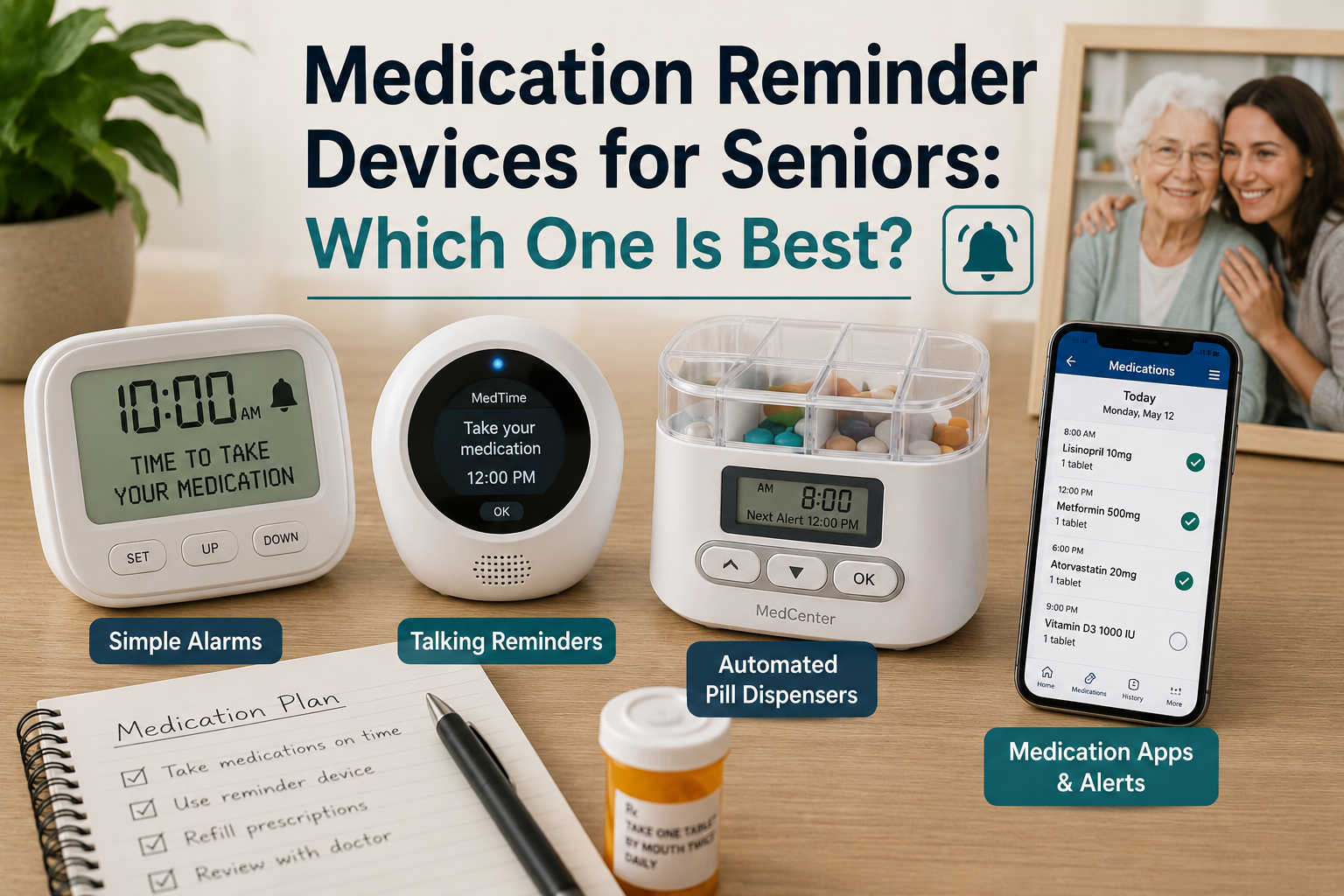
Medication Reminder Devices for Seniors: Which One Is Best?
Medication management looks simple from the outside. In reality, it is one of the most stressful parts of helping an older parent stay independent. Many families are not dealing with a refusal to take medicine. They are dealing with real-life friction: similar pill bottles, changing schedules, missed afternoon doses, confusion after a poor night of sleep, or the simple fact that aging hands and eyes make routines harder than they used to be.
That is why the best medication reminder device for seniors is not one universal product. It is the device type that matches the person, the number of medications involved, and the level of family support available. Some older adults only need a gentle prompt. Others need a system that dispenses pills, sends caregiver alerts, and reduces the chance of double dosing.
This guide explains the major categories of medication reminder devices, who each type is best for, and how families can choose without overbuying. If you are building a broader independence plan, this topic connects closely with 10 Smart Home Devices That Help Seniors Stay Independent and What Is Aging in Place and Why More Families Are Choosing It.
Table of Contents
- Why medication routines break down at home
- The main types of medication reminder devices
- Which type is best for different situations
- Features that matter most
- Common mistakes families make
- How to choose a device that will actually be used
- Frequently asked questions
Why medication routines break down at home
Most missed doses are not caused by carelessness. They happen because life gets noisy. A parent falls asleep in a chair. A meal runs late. The pill organizer was filled correctly, but the box looks the same as yesterday. A refill schedule changes. Vision, hearing, and memory all influence whether a routine stays stable.
Medication support is also emotionally sensitive. Many older adults want to remain in control of their own care, and they are right to feel that way. The best reminder devices respect that independence while giving just enough structure to prevent small mistakes from becoming patterns.
Families often notice this issue at the same time they start thinking more broadly about home safety and daily support. If that sounds familiar, it may help to review How to Make a Home Safer for an Elderly Parent Living Alone, because medication routines are part of the same larger independence picture.
The main types of medication reminder devices
Most devices fall into five practical categories. Each one solves a slightly different problem.
1. Basic alarm reminders
These are the simplest devices. They beep, flash, or vibrate at a scheduled time to prompt a dose. They work best for seniors who are still very capable of organizing medication but occasionally lose track of time.
Best for: straightforward schedules, one or two daily reminders, and people who want minimal technology.
Weak point: the device reminds, but it does not confirm whether the medication was actually taken.
2. Smart pill boxes with timed compartments
These systems add structure by pairing reminders with labeled or timed compartments. Instead of asking the person to remember which bottle and how much, the device helps organize the dose ahead of time.
Best for: seniors who can self-manage but benefit from better visual organization.
Weak point: the box still needs to be filled correctly and consistently.
3. Automatic dispensers
Automatic dispensers release the right dose at the right time and often lock the remaining medication between scheduled windows. This reduces the risk of double dosing or confusion between pills.
Best for: more complex schedules, memory concerns, or households where a caregiver wants better dose control.
Weak point: these systems are more expensive and may require a setup routine the family can maintain.
4. Connected caregiver-alert systems
Some medication devices send alerts to an adult child or caregiver if a dose is missed. This can be a strong middle ground between independence and oversight because it supports autonomy while still giving the family a way to notice problems early.
Best for: families supporting a parent from another home, another city, or another state.
Weak point: too many alerts can create fatigue if the system is not tuned carefully.
5. Voice-assistant-based reminders
Voice assistants can handle recurring reminders and verbal prompts, which is why some families use them as part of a medication routine. This approach can work surprisingly well when the schedule is simple and the person responds well to spoken prompts.
Best for: seniors already comfortable with voice routines and households that want a low-barrier starting point.
Weak point: voice prompts alone do not organize pills or confirm the dose was taken.
Which medication reminder device is best?
The best medication reminder device depends on the level of support required. There is no honest way around that.
For a senior who is mostly independent
A basic alarm reminder or a well-organized smart pill box is often enough. These tools support the routine without making the person feel managed. If the goal is simply to reduce occasional forgetfulness, starting simple is usually the right call.
For a senior with several medications each day
A smart pill box with strong visual organization or an automatic dispenser is usually the better choice. Once medication schedules become more layered, the risk comes less from forgetting the time and more from confusion about the dose itself.
For a parent living alone with adult children checking in remotely
A connected system that can alert a caregiver about missed doses may be the most useful. Families in this position are often trying to balance respect for privacy with a need to know when a pattern is slipping.
For a parent already using Alexa or another voice tool
Voice reminders can be an excellent support layer, but not always the full solution. They work best when combined with a simple physical organization method. If your family is exploring that route, use the dedicated tutorial to set up Alexa medication reminders, then compare whether a voice reminder is enough or a dedicated device is safer.
Features that matter more than marketing
Families can save time by focusing on the features that improve daily reliability rather than the features that sound futuristic.
Clear reminders
Audible alerts should be easy to hear, but they should also be distinctive enough to stand out from background noise. Flashing lights help when hearing loss is a factor.
Simple refill workflow
If refilling the device takes too long or feels error-prone, the system may not last. The best tool is one your family can maintain consistently.
Visible compartments or dose confirmation
Many families need a quick way to answer the question, Was that dose taken already? Devices that reduce ambiguity are usually worth the extra thought.
Remote alerts only when they matter
Caregiver notifications are useful, but too many nonessential alerts make families tune out. The best systems let you send attention only to missed doses or higher-risk situations.
Low cognitive load
The device should not require your parent to remember a dozen steps. Technology is helpful only when it reduces the mental load of staying on schedule.
Common mistakes families make
The first mistake is assuming that a more advanced device is automatically safer. Complex devices can solve real problems, but they can also introduce friction if the person using them feels confused or controlled.
The second mistake is buying a reminder tool when the real problem is regimen complexity. If there are many medications, multiple dose times, and frequent changes, the family may need a better workflow, not just a louder alarm.
The third mistake is ignoring how medication support fits into the rest of the home. A person who struggles with daily routines may also need better lighting, easier communication tools, or a simpler path to asking for help. That is why medication systems often belong inside a wider plan for independence, not as an isolated fix.
How to choose a device your parent will actually use
Medication routines can reveal when smart home help may be needed, especially if reminders, refills, or family check-ins keep breaking down.
Start with a conversation, not a purchase. Ask what feels difficult now. Is it remembering the time? Opening containers? Knowing whether a dose was already taken? Feeling rushed? Once the real friction is clear, the right device type becomes easier to spot.
Then test for fit:
- Can your parent understand what the device is asking them to do at the exact moment an alert happens?
- Can the family refill or manage it without creating a complicated maintenance burden?
- Does it preserve independence instead of taking over unnecessarily?
- Will it still make sense if routines change in six months?
In many homes, the best answer is not the smartest device. It is the device your parent feels comfortable with and your family can support consistently.
How medication reminder devices support aging in place
Medication routines are one of the quiet foundations of aging in place. When they stay stable, people feel more confident. Families worry less. Daily life stays predictable. When they break down, the household often feels fragile very quickly.
That is why medication support deserves the same thoughtful approach as smart lighting, door safety, and communication tools. It is not about turning the home into a clinic. It is about giving the person enough structure to stay independent safely for longer. If you are reviewing several risk areas at once, our aging in place checklist can help you step back and assess the bigger picture.
For families thinking beyond one device, the bigger framework in our aging in place guide can help connect the dots.
Final answer: which type is best?
If the question is which medication reminder device is best for seniors, the most accurate answer is this: simple alarms are best for straightforward routines, smart pill boxes are best for people who need organization, automatic dispensers are best for more complex or higher-risk schedules, and caregiver-connected systems are best when the family needs visibility from a distance. Voice reminders can be very useful, but they work best as part of a broader routine rather than the only safety net.
Choosing the right category first will usually matter more than comparing brands too early. Match the device to the real problem, and you are much more likely to end up with something that genuinely helps.
FAQ
What is the best medication reminder device for seniors living alone?
It depends on the medication schedule and the seniors comfort level. Many people living alone do well with a smart pill box or a caregiver-connected reminder system because those options balance independence with structure.
Are voice reminders enough for medication management?
They can help with simple routines, but they are usually not enough for complex medication schedules or for situations where dose confirmation matters.
Do automatic dispensers help prevent double dosing?
They can reduce that risk because they release medication only at the scheduled time and keep other doses unavailable in the moment.
Should families choose the most advanced device available?
Not necessarily. The best device is the one that fits the persons routine and can be maintained reliably by the family or caregiver.
Can medication reminder devices support aging in place?
Yes. They can reduce missed doses, add structure to the day, and help older adults remain independent at home with more confidence.