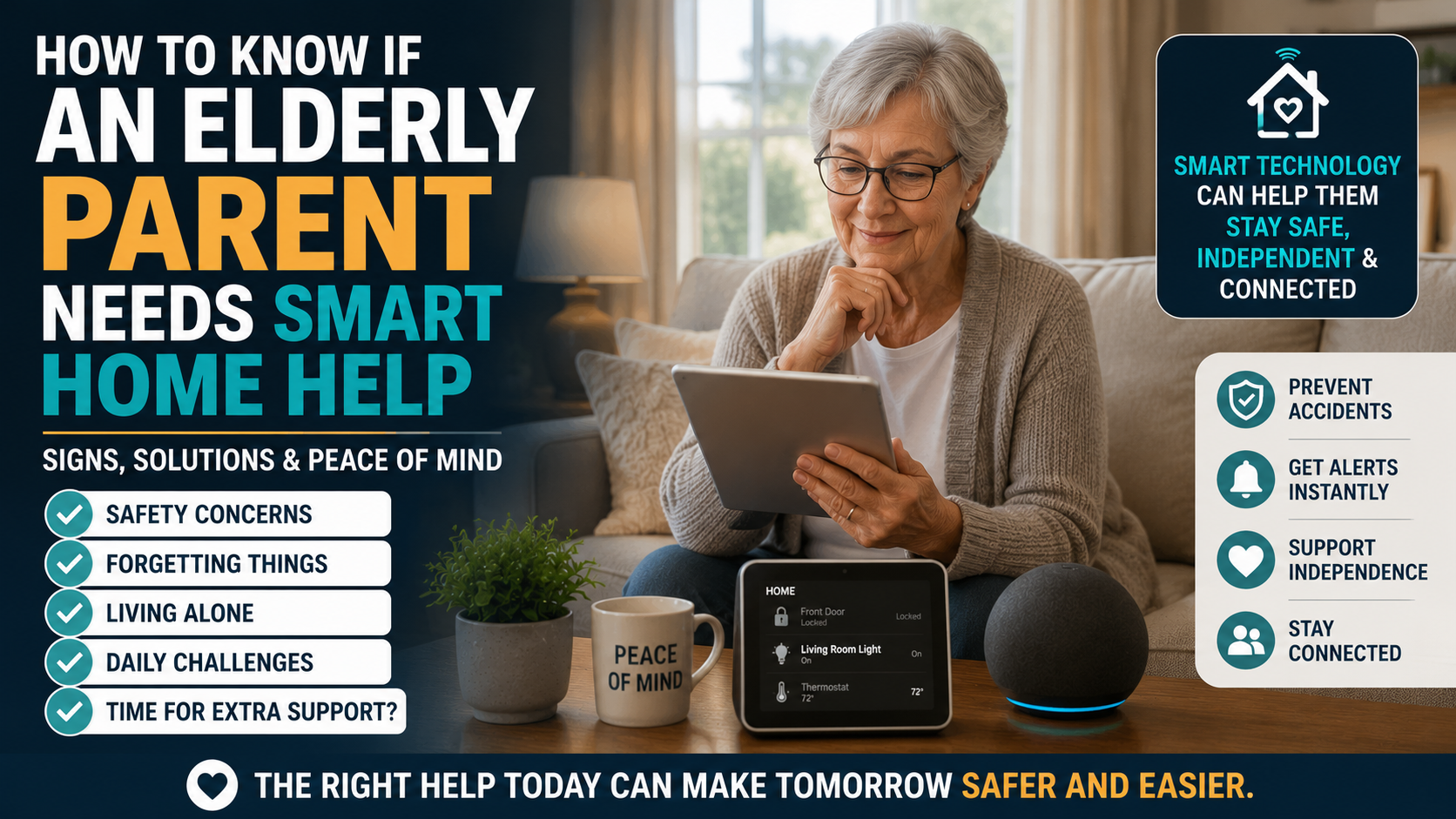
How to Know If an Elderly Parent Needs Smart Home Help
Quick Answer
An elderly parent may need smart home help when everyday tasks are becoming harder, reminders are being missed, lighting or safety issues are increasing, or family communication is becoming stressful. The best first step is not buying devices. It is identifying the specific problem technology should support.
Many families feel the same tension: they want to help, but they do not want to make a parent feel watched, pressured, or less independent. Smart home technology can help in the right situation, but only when it solves a real daily problem.
This is a decision-support guide, not a shopping list. For device examples, see our guide to smart home devices that help seniors stay independent.
Table of Contents
- Signs to watch for
- Decision table
- What to start with
- What not to solve with tech
- Decision path
- FAQ
Signs Smart Home Help May Be Useful
- Missed reminders are becoming common.
- Your parent avoids certain rooms or tasks.
- Lighting, stairs, or bathroom routines feel less safe.
- Family members worry when calls are not answered.
- Medication, appointments, or meals need more structure.
- Your parent wants help but dislikes complicated apps.
- Small tasks require more physical effort than before.
Decision Table
| Observation | Possible Support | First Question |
|---|---|---|
| Forgets appointments | Voice reminders or calendar alerts | Would a spoken reminder help? |
| Moves in the dark | Smart lights or motion lights | Which route is hardest at night? |
| Hard to reach by phone | Voice calling or smart display | Would calling by voice reduce friction? |
| Worries about home safety | Doorbell, sensors, safety checklist | What specific risk is most urgent? |
| Feels overwhelmed by devices | One-device setup | What is the simplest first win? |
Start With the Problem, Not the Product
The best smart home setup begins with one sentence: “We are trying to make this specific routine easier.” That routine might be remembering medication, turning on lights, calling family, or feeling safer at the front door.
If safety is the main concern, review our guide to making a home safer for an elderly parent living alone.
What Smart Home Help Can Support
- Reminders for daily routines.
- Hands-free calls.
- Lighting and nighttime movement.
- Front-door awareness.
- Simple routines that reduce steps.
- Family peace of mind without constant check-ins.
What Technology Should Not Replace
Smart devices should not replace medical care, emergency services, caregivers, or honest family conversations. If your parent has repeated falls, sudden confusion, unsafe driving, medication errors, or major health changes, seek professional guidance.
A Three-Question Fit Test
- What specific task is becoming difficult? Describe the repeated problem without naming a product: a dark hallway, missed family calls, difficulty reaching a switch, or uncertainty about a daily routine.
- Does the older adult want the proposed help? A useful device still needs consent, understandable controls, and a clear way to stop using it.
- Who will maintain the setup? Decide who handles passwords, updates, batteries, subscriptions, false alerts, and troubleshooting before buying.
Choose the Least Complex Fix That Solves the Problem
The answer may be a brighter bulb, a relocated object, a written routine, a local service, or family support rather than a connected device. The National Institute on Aging’s aging-in-place guidance recommends starting with the help needed now, planning for future needs, correcting immediate home hazards, and revisiting the plan as circumstances change.
If technology is appropriate, start with one narrow task and keep a manual fallback. Move to multiple connected devices only after the first setup has proved understandable and useful. If the concern involves falls, medication errors, wandering, major cognitive change, or inability to complete daily activities, technology selection should follow an appropriate professional or care assessment rather than lead it.
Decision Path
- If the issue is memory: consider simple reminders before sensors.
- If the issue is movement at night: review lighting and fall risks first.
- If the issue is communication: try voice calling or a simple display.
- If the issue is front-door safety: consider whether a doorbell or lock review is appropriate.
- If the issue is broad decline: involve professionals before relying on devices.
Conversation Tips
Lead with independence. Instead of saying, “You need monitoring,” try, “Would it make mornings easier if the lights and reminders were simpler?” Respect matters. Technology works best when the older adult understands and agrees with the purpose.
For broader planning, use our aging in place checklist.
Frequently Asked Questions
What is the first smart home device for an elderly parent?
Usually the best first device is the one that solves the clearest problem, such as a voice assistant for reminders or a smart light for nighttime safety.
How do I avoid making my parent feel monitored?
Ask permission, explain the purpose, and start with supportive tools rather than surveillance-style devices.
Can smart home technology help aging in place?
It can support aging in place when paired with home safety, family communication, and realistic planning.
Should I buy several devices at once?
No. Start with one or two practical tools and review whether they are actually being used.
When is technology not enough?
If safety risks are frequent, medical issues are changing, or daily care needs are increasing, professional support may be needed.
30-Minute Family Review
- List the top three worries.
- Match each worry to a daily routine.
- Ask your parent what feels hardest.
- Choose one low-friction improvement.
- Review after two weeks.