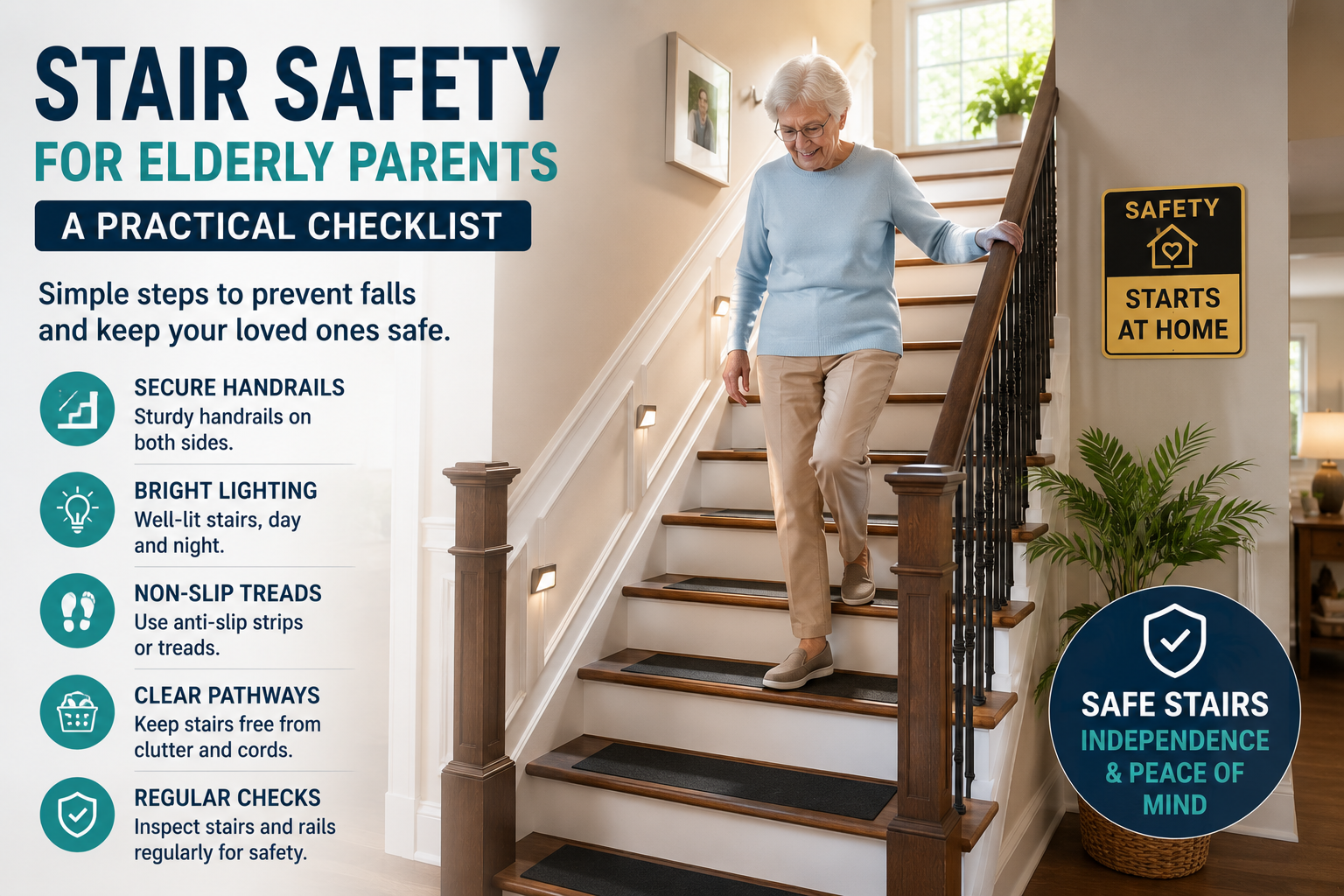
Stair Safety for Elderly Parents: A Practical Checklist for Families
Quick Answer
Stair safety for elderly parents starts with secure handrails, bright lighting, visible step edges, clear stairs, non-slip surfaces, and careful attention to how your parent actually uses the stairs. If there have already been falls or major balance changes, seek professional assessment.
Stairs can become stressful before a family realizes there is a serious issue. A parent may pause longer, grip the wall, avoid carrying laundry, or choose not to go upstairs as often. Those small changes are worth noticing.
This article is stair-specific. For a whole-home review, use our room-by-room home safety checklist for seniors.
Table of Contents
- Why stairs deserve attention
- Stair safety checklist
- What to look for
- High-priority changes
- Decision path
- FAQ
Why Stairs Deserve Special Attention
Stairs require balance, strength, vision, timing, and confidence. Lighting, rail height, footwear, distractions, pets, and carrying objects can all affect safety.
Families should avoid assuming a staircase is fine just because it has always been there. Needs change over time.
Stair Safety Checklist
- Check that handrails are secure and easy to grip.
- Make sure lighting covers the full staircase.
- Remove clutter from every step.
- Check for loose carpet, slippery treads, or uneven edges.
- Make step edges easy to see.
- Review footwear used on stairs.
- Watch whether your parent carries heavy items.
- Check top and bottom landings.
- Confirm light switches are reachable at both ends.
- Ask whether stairs feel harder at certain times of day.
What to Look For
| Feature | Why It Matters | What to Check |
|---|---|---|
| Handrails | Support during ascent and descent | Secure mounting, grip comfort, both sides if possible |
| Lighting | Step depth and edges must be visible | No shadows, reachable switches, nighttime visibility |
| Step surface | Slippery or loose surfaces increase risk | Carpet, tread, nosing, worn areas |
| Clutter | Objects on stairs create trip hazards | Laundry, shoes, packages, pet toys |
| Landing | Transitions require turning and balance | Clear space, lighting, rug edges |
Highest-Priority Changes
Secure handrails
A handrail that moves, feels too thin, or stops too early is not reliable. Consider professional installation where needed.
Improve lighting
Good stair lighting should show every step. Shadows can make depth harder to judge.
Make step edges visible
Contrast can help seniors see where one step ends and the next begins, especially in low light.
Remove stair clutter
Stairs should not be used as temporary storage. Even one object can change footing.
Review daily routines
If laundry, medication, or meals require frequent stair trips, look for ways to reduce unnecessary carrying.
Use an Evidence-Based Stair Check
The CDC recommends railings on both sides of stairs and enough lighting throughout the home. Its Check for Safety checklist also asks families to remove objects from stairs, repair loose or uneven steps, secure or remove loose carpet, and provide light switches at both the top and bottom.
Walk the stairs with the older adult during the day and after dark. Check whether each handrail is secure for the full flight, whether the first and last step are easy to distinguish, and whether the person carries items because needed objects are stored on another floor. A motion light can support visibility, but it does not correct loose steps, poor balance, unsafe footwear, or a missing rail.
If the person has fallen, feels unsteady, cannot use the rail, or avoids the stairs, ask a qualified health professional or home-safety professional for an individual assessment. Building and handrail requirements vary by location, so structural work should follow local requirements rather than generic online measurements.
Decision Path
- If grip is the issue: start with handrail security and shape.
- If visibility is the issue: improve lighting and step contrast.
- If slipping is the issue: review tread surface and footwear.
- If carrying items is the issue: change routines or add storage on each level.
- If falls have occurred: seek professional guidance.
When Stairs May No Longer Be Practical
Sometimes stair improvements are not enough. Repeated falls, dizziness, severe fatigue, or fear of stairs may require a bigger plan, such as moving daily activities to one level or consulting a professional.
For broader fall-risk planning, see our fall prevention checklist for seniors.
Frequently Asked Questions
Are handrails enough to make stairs safe?
Not always. Handrails help, but lighting, surface, clutter, footwear, and mobility also matter.
Should stairs have handrails on both sides?
Two handrails can help some seniors, but layout and installation matter. A qualified installer can advise.
How can I make stairs easier to see?
Improve lighting, reduce shadows, and consider contrast at step edges.
What should be removed from stairs?
Remove shoes, laundry, packages, decorations, cords, and pet items.
When should we stop using stairs?
If stairs are causing repeated falls, fear, or major fatigue, consult a professional and consider one-level living options.
30-Minute Stair Review
- Walk the stairs slowly with lights as normally used.
- Check each rail for movement.
- Remove every object from the stairs.
- Look for shadows and worn spots.
- Ask your parent where they feel least confident.
- Prioritize one repair, one lighting fix, and one routine change.