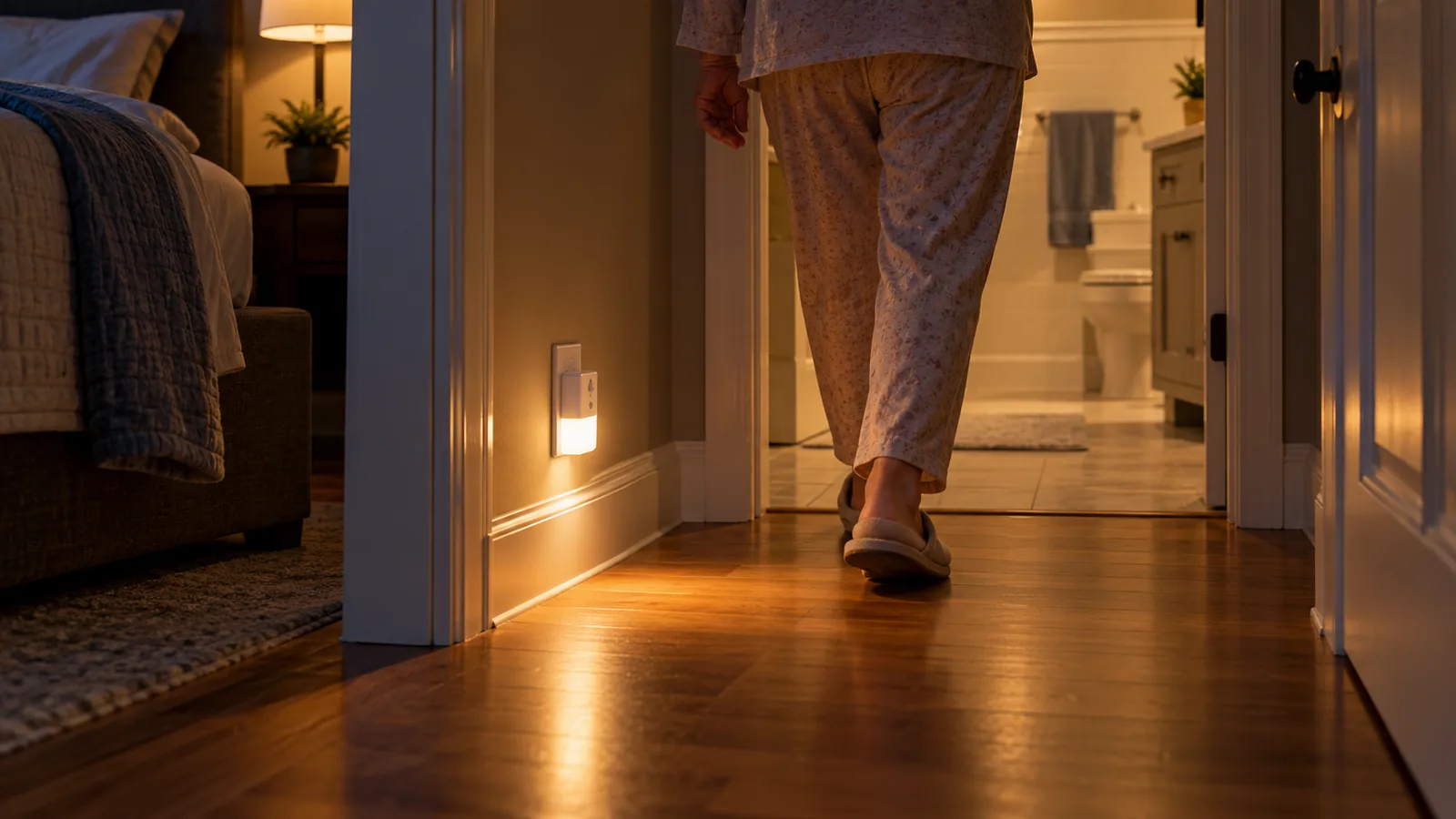
Motion Sensor Night Lights for Seniors: How to Choose Plug-In, Battery or Hardwired
Quick answer: If there is an outlet along the route from the bed to the bathroom, a plug-in motion night light is usually the simplest choice. Use a battery light where there is no outlet, and plan to check the batteries. Hardwired lights suit stairways and long halls when an electrician can install them. Whatever you pick, try it at night before you rely on it (the five-minute test is below), and keep the floor clear. A light helps someone see; it does not make walking safe by itself.
Why families install motion lights
The NIA advises keeping a light on in the bathroom at night or using a night light that turns on automatically in the dark, and putting night lights and light switches close to the bed. It also suggests keeping a flashlight by the bed in case the power goes out. NIH adds good lighting at the top and bottom of stairs and at each end of a long hall. (NIA room-by-room guide, NIH falls topic). A motion sensor does that automatically, so nobody has to find a switch.
This guide is about choosing and checking the light. For the evening routine and the rest of the room, see our nighttime safety checklist.
Choose in 60 seconds
| If your situation is… | Consider |
|---|---|
| Outlet near the bed, hallway or bathroom door | Plug-in motion night light |
| No outlet on the route, or a spot where cords are awkward | Battery motion light |
| Stairway, entry or long hall; you are renovating | Hardwired motion lighting (electrician) |
| Frequent power cuts | Battery light as well as a flashlight by the bed |
The three types, plainly
Plug-in. It sits in an outlet, so the light itself needs no battery changes. It still needs a periodic check that it turns on. Good fit: bedroom, hallway, bathroom with an outlet in reach. Limits: it occupies an outlet and stops when the power fails.
Battery. It can go where there is no outlet. Limits: someone has to replace or recharge the batteries, and a dead battery looks like a broken light. A standalone battery light does not need Wi-Fi, an app or the power grid. It still needs maintenance.
Hardwired. Wired into the home, sometimes with a wall switch. It is the most permanent option and suits stairs and entries. Installation normally needs a licensed electrician and has to meet local code.
Example listing in the plug-in category
The L LOHAS motion night light (2-pack, plug-in) is one example of a plug-in model families look at. The manufacturer’s Amazon listing states: two brightness levels (30 and 60 lumens); three modes (on, off and automatic), where automatic mode turns on when it detects motion in the dark; a motion range of about 3 to 5 meters at up to 120 degrees; an automatic shut-off about 60 seconds after motion stops; a 3000K color temperature; and a maximum power draw of 0.6 W. These are the manufacturer’s stated figures. We have not tested the product or verified them independently. Check the current listing before buying, because prices and specifications change.
Affiliate link: L LOHAS plug-in motion night light, 2-pack, on Amazon Affiliate link — we may earn a commission if you purchase.
What to check before you buy
- Does it switch on before the first step? The sensor should detect you as you sit up or stand at the bedside, not two steps later. Range and angle on the box are claims; the night test shows what happens in your room.
- Sensor position. Put it where it sees the route, not facing a wall. Mount low enough to light the floor.
- Brightness and glare. Look at the light from the bed and from the toilet. If it is uncomfortable to look at, it is too bright or too exposed. Lower brightness or a light that is pointed down can help.
- Off delay. The listing says how long it stays on after motion stops. Too short and it may switch off while someone is standing still (for example, at the sink); too long and it stays on without need.
- Upkeep. Plug-in: no battery changes, but a periodic check that it still turns on. Battery: who checks the batteries, and when.
- Place it fits. Outlet height and position, tight spots, stairs, steam in a bathroom, and any manufacturer limits on where it may be used.
- Power cuts. A plug-in light stops with the power. Keep a flashlight by the bed (see our power outage guide and backup power plan).
A five-minute night test (a family member does it first)
Safety comes first. A family member runs this test before the parent uses the light. Keep a backup light ready, such as a second lamp or a flashlight, and never ask a person who is at risk of falling to walk the route in the dark to test it.
- Make sure the backup light works. Then turn off the other lights and wait for the night light to switch off.
- The family member sits up and stands at the edge of the bed, as the parent would. Does the night light come on before the first step?
- Walk the route to the bathroom slowly, and note any dark gap and whether the light follows.
- Stop for 30 seconds in the bathroom doorway. Does the light stay on while someone is there? If it switches off, move the light or choose another model.
- Look at the light from the bed and from the toilet. Is it harsh?
- Ask your parent what feels easy. Their answer matters more than the numbers on the box.
Repeat the test after any move of the light, and check battery models monthly.
What these lights cannot do
- They do not eliminate the risk of falls. They can make a step or a rug easier to see; they do not fix balance, weakness or medication effects.
- They are not a medical alert or an emergency call.
- A basic night light does not message anyone. Alerts need a separate device.
- Specifications vary, so check each model’s listing.
If walking has become unsteady, talk with a doctor or physical therapist, and see our fall prevention checklist and room-by-room checklist.
FAQ
Is plug-in or battery better for seniors? Plug-in is simpler if there is an outlet on the route. Battery is for places with no outlet and needs a routine check.
Do motion night lights work in a power outage? Plug-in models do not. Battery models do.
Should the light stay on all night? Many families prefer motion activation with a short off delay. Use the night test to decide what works for your parent.
Do I need an electrician? For hardwired lighting, yes. Plug-in and standalone battery lights need no wiring.
Conclusion
Pick the type that fits the route, the outlets and the power situation. Test it at night, keep the path clear, and treat the light as one part of a safer evening, not a guarantee.