Water Leak Sensors for an Older Parent’s Home: Where to Put Them and What They Can’t Do
A water leak sensor can give an older parent and their family an earlier warning when water reaches a particular spot. It is a small addition to a home safety plan, not a promise that every leak will be found or that damage will be prevented. The useful question is not “Which gadget is best?” but “Where could water collect unnoticed, who will receive the alert, and what will they do next?”
Quick answer: Start with the places most likely to hide a leak: under a sink, beside a water heater, or near a washing machine. Put a moisture sensor where water would actually reach its contacts, following that model’s instructions. Choose an audible alarm if someone nearby can hear it; choose remote notifications only after checking the required hub, internet connection, phone settings, and backup plan. Test the entire alert path with the older adult before relying on it.
What a water leak sensor does—and does not do
Most small, floor-level leak sensors detect moisture when water touches their sensing contacts or a connected probe. A basic model may sound an alarm; a connected model may also notify a phone. The EPA WaterSense guide to leak detection distinguishes these point-of-use moisture sensors from systems that monitor water flow at a fixture or the main supply line.
That distinction matters. A sensor under the kitchen sink may notice water pooling there, including a drain leak that a main-line flow monitor might miss. It will not detect a leak behind a wall, at another sink, or upstream of its position. A typical standalone moisture sensor also does not turn off the water; automatic shutoff requires a compatible, separate system. No sensor replaces checking plumbing and appliances or repairing a leak after it is found.
Where to put sensors first
Walk through the home with the older adult, if possible. Look for water connections, hard-to-see floors, past leaks, and places where a puddle could spread before anyone notices. The EPA’s Free of Water Leaks technical sheet identifies fixtures and appliances worth checking, including sinks, toilets, dishwashers, clothes washers, and water heaters. Sensor placement then depends on the room’s layout and the manufacturer’s instructions.
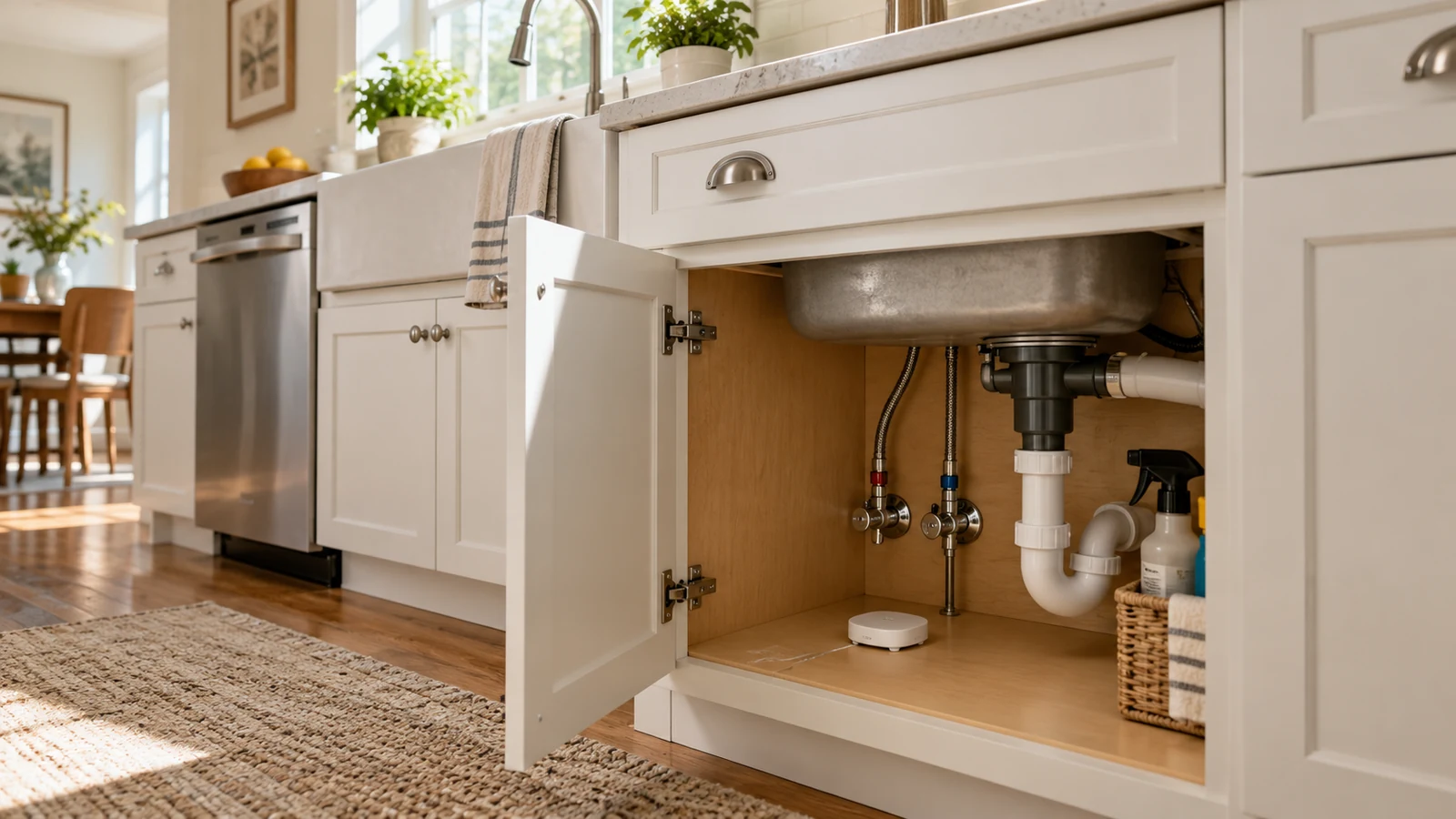
- Kitchen and bathroom sinks: Put a sensor on the cabinet floor near supply connections or beneath the drain where water would collect. Keep it accessible when household items are moved. Our kitchen safety guide covers the wider room.
- Toilets: Consider the floor near the tank’s supply connection or behind the toilet, without blocking cleaning or normal use. A floor sensor will not necessarily detect a toilet that silently runs water into the bowl; that is a different problem.
- Washing machines: A sensor behind or beside the washer can help notice water from a hose or connection, if it is placed where water will reach it and remains retrievable for testing. Do not wedge it into the appliance.
- Dishwashers: If there is an accessible floor area near the appliance or its supply connection, place a sensor where a leak might emerge. Do not assume a sensor outside the cabinet can detect water trapped beneath the machine.
- Water heaters: Look at the floor near the unit or its supply connections, following the device’s heat and placement limits. Leave service access clear.
- Basements and utility areas: Consider low spots or nearby equipment where water might collect. A remote phone alert can be especially useful where a local alarm would not be heard upstairs. For broader room-by-room priorities, use our home safety checklist.
You do not need to cover every possible location on day one. Start with one or two places that are both plausible leak points and easy to inspect. Add coverage only after the first sensors prove easy to maintain.
Placement mistakes that weaken the warning
A sensor has to meet the water. Placing it on a high shelf, far from a likely pooling area, or behind stored boxes can make an alert less likely or harder to investigate. At the same time, a spot regularly splashed during cleaning may cause nuisance alarms. Check the model’s contact or probe orientation, floor-surface requirements, operating temperature, and guidance on humid locations. If a drain or appliance sits inside an enclosed cavity, ask whether the sensor can actually reach the first water that escapes.
Take a photo of each installed location and record its name in the app or family checklist. “Kitchen sink” is more useful than “Sensor 1” when a relative receives an alert from miles away. Keep the sensor out of walking paths and do not make the older adult bend into a difficult space just to silence it.
Local alarm or phone alert: who will really notice?
A local audible alarm is simple: someone in or near the home must hear it and know what it means. Consider hearing loss, closed doors, a basement location, or times when nobody is home. Do not treat a stated alarm volume as proof it will be heard in this particular house; test it from the rooms the resident uses.
A connected sensor can be more useful for a family caregiver who lives elsewhere, but the route from sensor to phone has more links. Depending on the model, it may need a separate hub, Wi-Fi, a powered router, an active internet connection, the manufacturer’s service, and phone notifications that have not been silenced. A battery in the sensor does not by itself keep the hub or router running during a power outage. The EPA recommends considering the alert method, battery requirements, and connection maintenance when choosing a device. Our guides to internet and power outages and backup power explain the wider household plan.
Before purchase, ask: Does this exact model sound locally, send phone alerts, or both? Is a hub included or sold separately? Can more than one trusted person receive notifications? What happens when the internet, hub, or power fails? The answers vary by product; do not infer them from a “smart” label.
A simple selection guide
| Household need | Feature to verify | Important limit |
|---|---|---|
| Someone is usually home and can hear alarms | Local audible alarm and a test function | It may be missed in another room or while away. |
| Family monitors the home from elsewhere | Phone alerts, recipient sharing, and exact hub requirements | Remote delivery depends on the full connection path. |
| The house has frequent outages | Battery operation and documented behavior without Wi-Fi or power | Sensor battery power does not guarantee phone alerts. |
| Automatic water shutoff is needed | Compatible shutoff system and installation requirements | A basic floor sensor cannot shut off a supply line by itself. |
For a main-line shutoff device, check pipe compatibility and installation requirements with a qualified plumber. The EPA notes that in-line systems usually require professional installation and that shutoff arrangements must not interfere with home fire-sprinkler protection. This is a different decision from placing a small battery sensor under a sink.
Install and maintain a sensor the family can rely on
The best arrangement is the one someone will actually check. Use this short checklist when setting up a sensor:
- Choose a realistic leak location and identify where water would first collect.
- Read the exact model’s instructions for contact placement, hub pairing, batteries, and testing.
- Place the sensor without blocking access, cleaning, or a walking path; label its location clearly.
- Trigger the manufacturer-approved test. Check both the local sound and each intended phone notification, if offered.
- Ask the older adult whether the alarm is recognizable and what they would do when it sounds. Assign a family member to respond to remote alerts.
- Record a reminder to test it again as the manual directs, check batteries, keep contacts clean, and confirm the sensor has not been moved.
- After a Wi-Fi password change, router replacement, or outage, check that connected alerts still work.
The EPA specifically recommends cleaning and correctly positioning moisture sensors, testing according to the user manual, replacing batteries as needed, and checking reconnection after changes to internet service. A periodic family walkthrough is also a chance to inspect visible hoses and connections; an alarm is not a substitute for those checks.
What to do when an alert arrives
Agree on a response plan before the first alert. A remote caregiver can contact the resident, confirm which location triggered, and arrange a trusted local person to look when appropriate. If the water source is clear and it is safe to act, the household may use an accessible shutoff valve or call a plumber. If the source is uncertain, the leak is spreading, or the resident cannot investigate safely, seek qualified local help rather than asking them to move heavy appliances or work around utilities.
Water near electrical equipment is a safety issue, not a routine sensor test. Do not touch wet electrical equipment or stand in water to operate it; seek professional or emergency help as appropriate. Ready.gov’s flood safety guidance reinforces that caution. For a minor nuisance alert with no water found, inspect for splashes, condensation, sensor movement, or dirty contacts, and follow the manufacturer’s troubleshooting steps before trusting it again.
Frequently asked questions
Can a leak sensor prevent water damage?
It can provide an earlier warning at the spot it monitors. The outcome depends on someone receiving the alert and responding in time. A basic sensor does not stop water flow; even an automatic shutoff system has installation and coverage limits.
Will it work if the internet goes out?
That depends on the exact model. A battery-powered sensor may still sound locally, but remote notifications can fail if its hub, router, internet connection, or cloud service is unavailable. Confirm this behavior in the product documentation and test a safe, manufacturer-supported scenario.
How many sensors does an older parent need?
There is no universal number. Prioritize the home’s layout, past leaks, hard-to-see areas, and who can maintain the devices. One well-placed, routinely tested sensor may be more useful than several untested ones.
Can I put one behind the toilet or dishwasher?
Only if the sensor remains within its specified environment, is accessible for maintenance, and sits where escaping water could reach it. A running toilet or water hidden beneath a dishwasher may not wet a nearby floor sensor.
Bottom line
A leak sensor is useful when its location, alert path, and response plan match the household. Start small, test with the older adult, and keep ordinary plumbing checks in the routine. If you are reviewing more than water risks, our room-by-room home safety checklist offers a broader starting point; it does not replace plumbing work or emergency help.